
Technology
Flexible armour instead of rigid plates
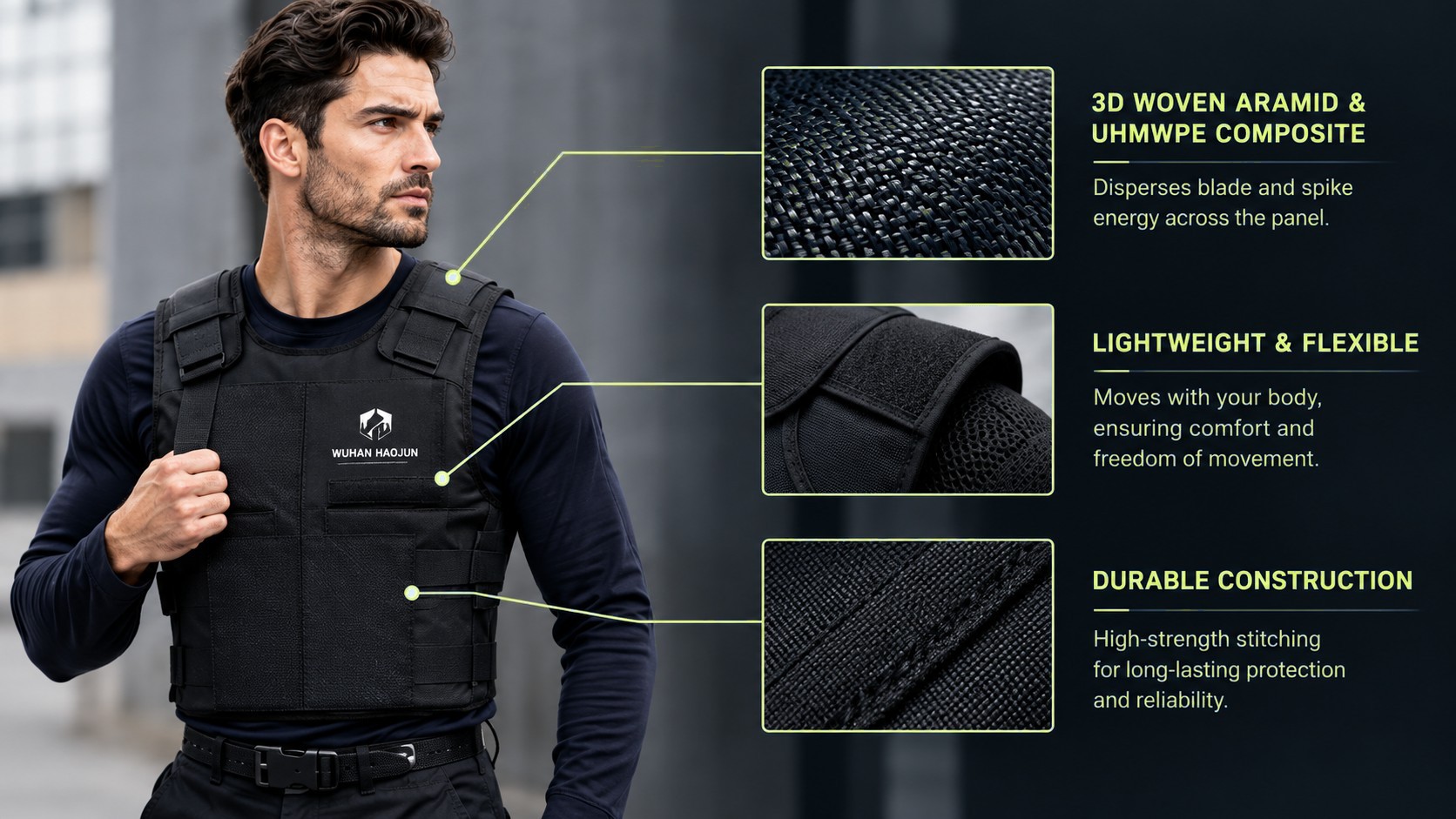
Our current platform, WUHAN HAOJUN third-generation anti-cutting and stabbing technology, replaces metal inserts with a 3D woven aramid and UHMWPE composite that disperses blade and spike energy across the panel instead of deflecting it. The result is protection measured in millimetres, not centimetres.
Seven engineering decisions
What makes the composite work
The material and process choices behind the current platform.
- 01
Only aramid and UHMWPE are used - carbon fibre, which is harmful to the body, is excluded.
- 02
410D aerospace-grade filament yarn, with single-yarn specific strength about ten times that of steel wire.
- 03
3D weaving reaches an areal density of 700 g/m2, against roughly 580 g/m2 in comparable products.
- 04
Eco-friendly resin impregnation removes puncture blind spots.
- 05
Finite-element simulation of the failure mechanism: a single 1.5 mm layer withstands 2,931 N of puncture force.
- 06
32 standardised production steps from fabric to finished garment.
- 07
Nine-segment non-overlapping stitching keeps protective layers continuous at every seam.
Measured performance
Material and process data
Figures published in our catalogues and test documentation. Original reports are available to procurement contacts.
Areal density
Up to 700 g/m2
Comparable products approx. 580 g/m2
Puncture resistance
2,931 N
Single 1.5 mm layer, finite-element verified
Yarn
410D aerospace grade
Specific strength approx. 10x steel wire
Production steps
32
Plus nine-segment non-overlapping stitching
Breathability
208 mm/s
Catalogue test figure
Moisture vapour transmission
6,860 g/(m2-24h)
Catalogue test figure
UV protection
UPF > 2000
Catalogue test figure
Antibacterial rating
3A
Catalogue test figure
Softness
18.9 cN-cm
Catalogue test figure
Water resistance
Level 4
Catalogue test figure
Body temperature reduction
2-3 C
Measured by CITC
Ballistic-side principle
How the protection works
With each penetration of a protective layer, the projectile loses a small amount of kinetic energy. Until the kinetic energy is exhausted, the projectile is blocked — that is the basis of protection.
Five energy-absorption mechanisms
- 01Tensile deformation of the protective layer
- 02Layer destruction
- 03Thermal energy loss
- 04Projectile deformation
- 05Energy consumption during impact-induced vibration
Platform
What the protection platform is built on
Next step
Need the technical dossier?
Send us the threat level and end use. We share material data, test reports and construction drawings for the styles that fit your requirement.